Kelly Butte: Reading the High Cascades
August 16, 2026 · Kelly Butte Trail, Washington Cascades
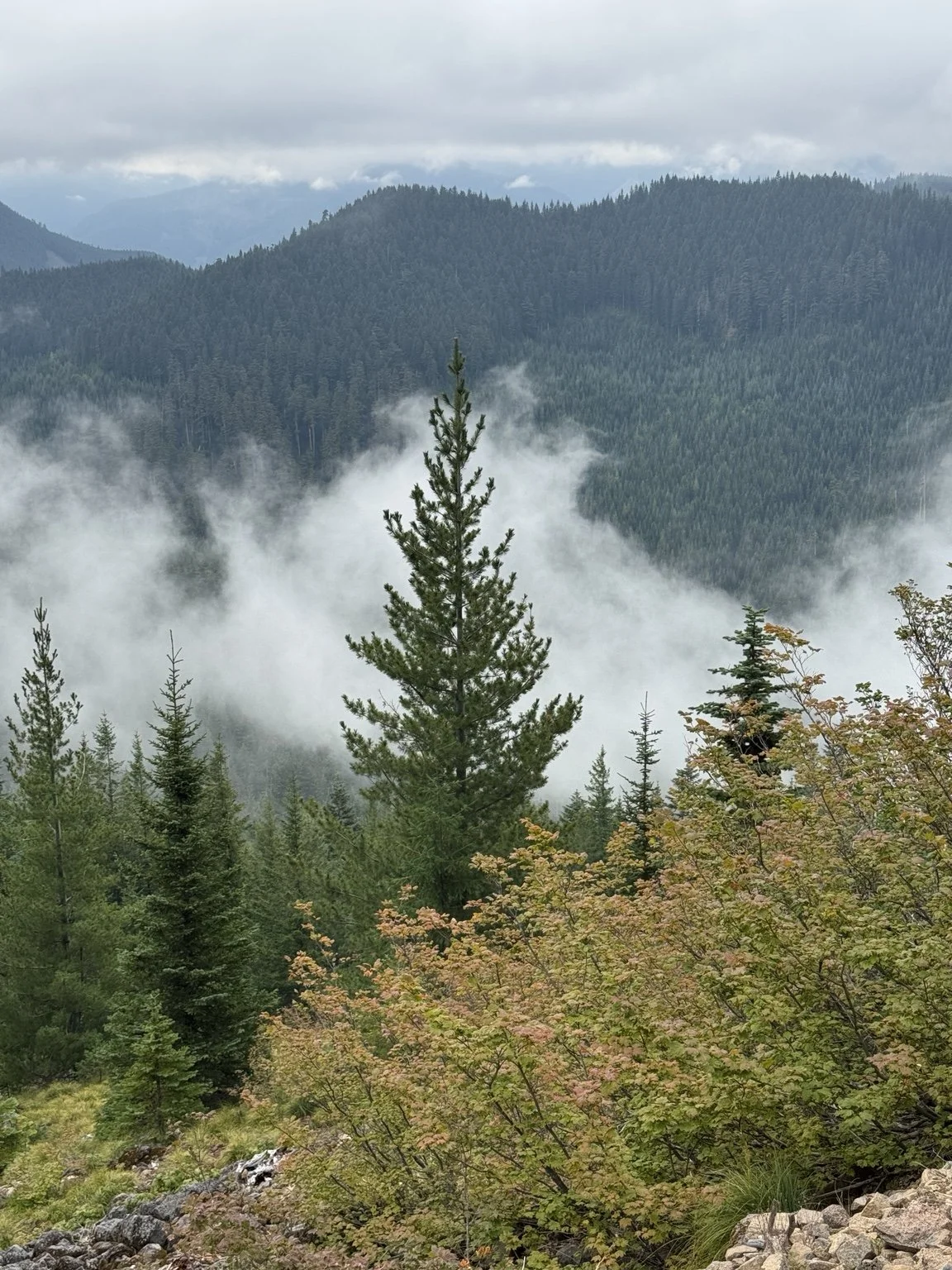
Kelly Butte turned out to be almost a perfect hike for seeing how a Cascade forest changes with elevation.
The hike was just under four miles round trip, but it packed roughly 1,100 feet of climbing into a relatively short distance. The trail began above 4,000 feet, followed a comparatively gentle approach through montane forest, and then climbed steeply toward the summit and its fire lookout at roughly 5,400 feet. By the time I returned to the trailhead, I hadn't covered an enormous distance—but I had walked through a surprisingly rich collection of Cascade conifers.
And, as often happens when I go looking at trees, one of the day's best discoveries was something I wasn't looking for at all.
Starting high
There really wasn't a lowland forest on this hike. Even the trailhead was around 4,200 feet.
The relatively flat lower section was dominated by trees I know well from the western Cascades, although at considerably higher elevations than where I usually encounter some of them: western hemlock (Tsuga heterophylla), Douglas-fir (Pseudotsuga menziesii), Pacific silver fir (Abies amabilis), and western white pine (Pinus monticola). Vine maple (Acer circinatum) occurred in the understory.
Western white pine was particularly noticeable. I saw enough of them during the day to spend some time examining the foliage closely. Its five-needle bundles are long, soft and relatively delicate, giving the tree a distinctive fluffy appearance from a distance. Even easier to spot were some of its enormous hanging cones.
That familiarity would unexpectedly become useful later.
As the trail approached roughly 4,400–4,500 feet, the terrain changed. The gentle approach reached rocky slopes and ledges, and then the serious climbing began.
The forest changed with it.
Into the snowy forest
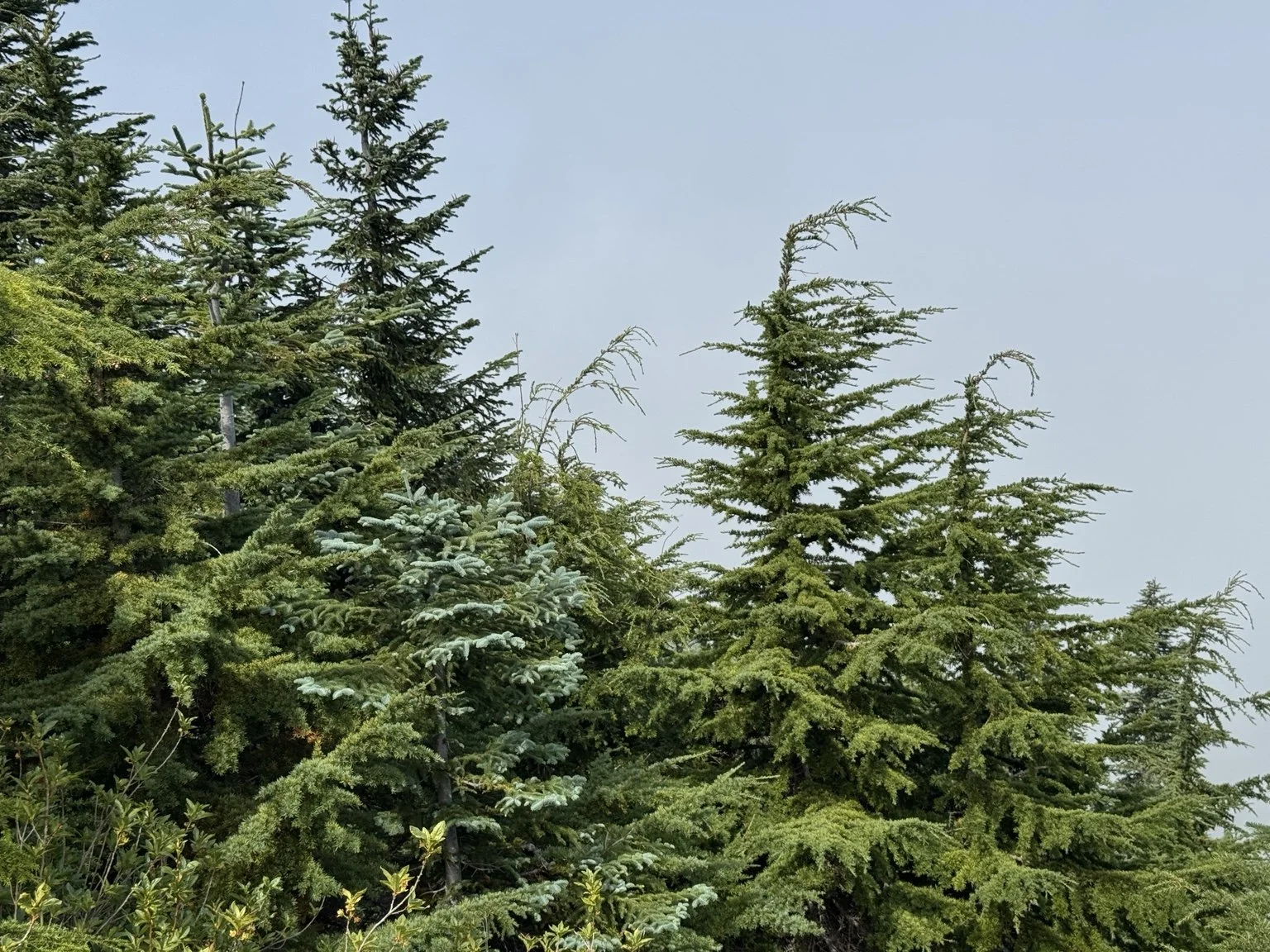
Higher on Kelly Butte, three trees became especially conspicuous: mountain hemlock (Tsuga mertensiana), subalpine fir (Abies lasiocarpa), and Alaska yellow-cedar (Callitropsis nootkatensis).
Mountain hemlock was abundant and beautiful. Its irregular form and characteristically drooping leader made it increasingly easy to recognize as the day went on. Subalpine fir was also common, with its narrow, almost exaggeratedly spire-shaped crown. Alaska yellow-cedar appeared repeatedly, including some wonderful older trunks with peeling gray bark revealing reddish tones underneath.
Together, those three species say something about this landscape even on a warm August afternoon:
Snow. And lots of it.
Kelly Butte may not occupy the snowiest part of the Cascades, but this entire hike occurs at elevations that receive substantial winter snow. Even the Douglas-firs, western hemlocks, western white pines and vine maples down around 4,200–4,500 feet aren't living in some mild, snow-free forest. They're trees capable of enduring a serious mountain winter.
Higher up, though, snow becomes an increasingly important ecological filter. Mountain hemlock, subalpine fir and Alaska yellow-cedar are trees extraordinarily well suited to cold environments with deep, persistent snowpacks and short growing seasons.
It was fascinating to see that transition happen over barely a thousand vertical feet.
Douglas-fir didn't disappear immediately, either. Individual trees persisted surprisingly high on the butte. One growing around the rocky transition area particularly caught my attention. Farther down, Douglas-fir had simply been part of the forest. Up here, individual trees increasingly seemed like holdouts from the forest below.
The pine that looked wrong
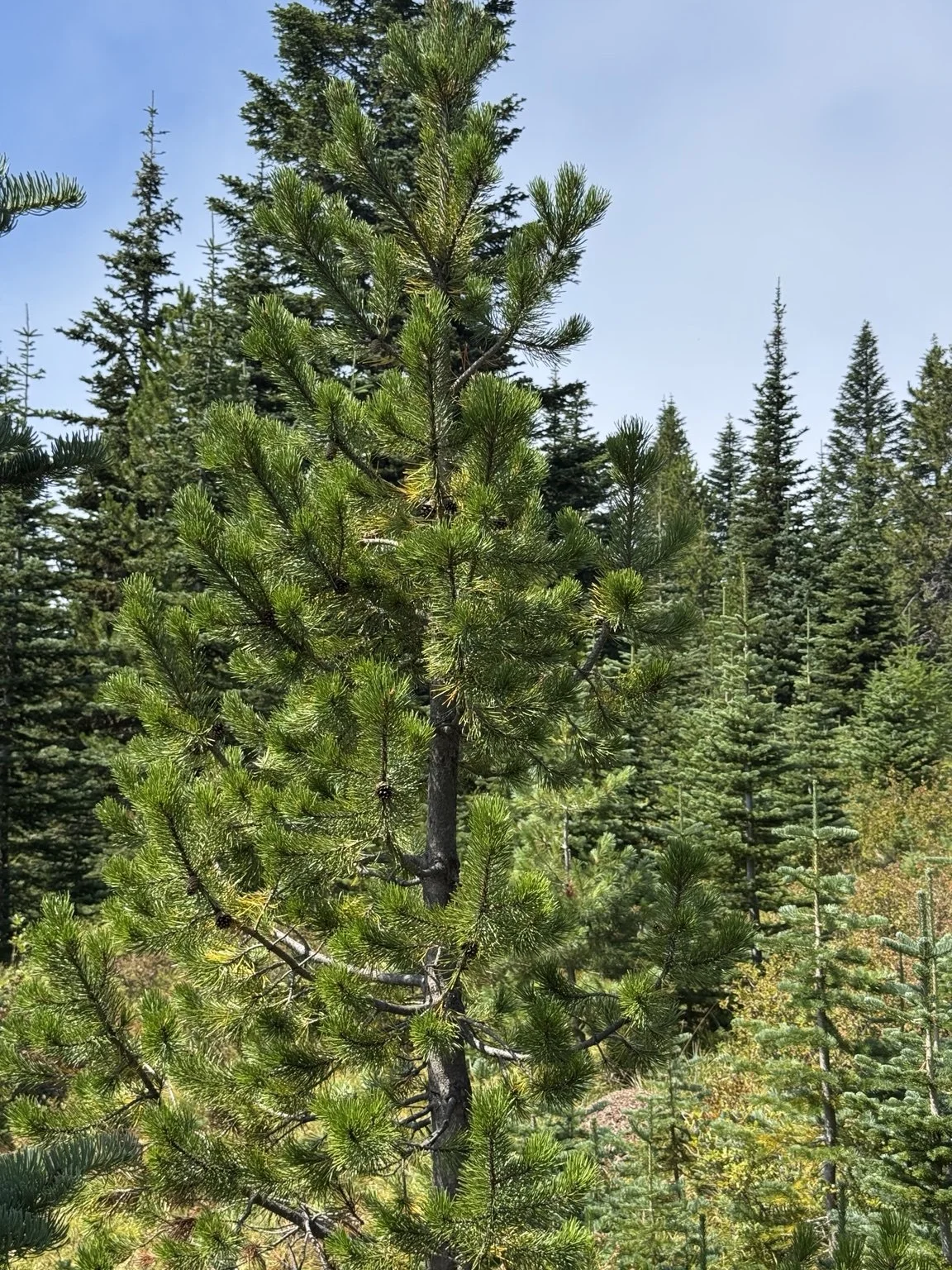
Somewhere high on the climb, at an altimeter reading of about 5,268 feet, I noticed another pine.
I'd been seeing western white pine throughout the hike, but this one didn't look right.
The color was wrong. The foliage didn't have that soft western-white-pine appearance. And the needles seemed much too short.
So I left the trail and walked perhaps 10 or 15 yards over to investigate.
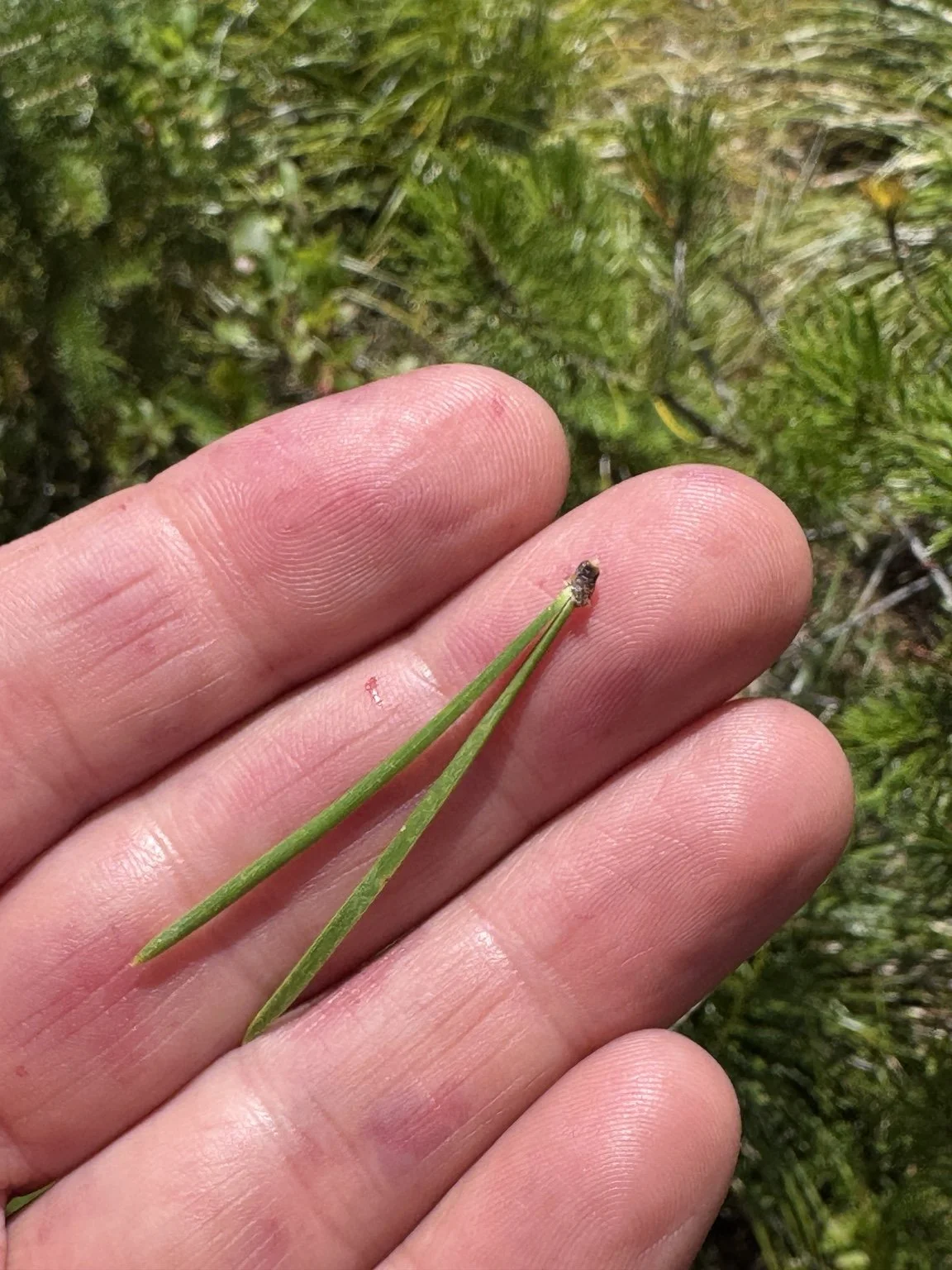
Once I got my hands on the foliage, there wasn't much ambiguity about the first important question.
Two needles per fascicle.
Definitely not western white pine.
The photographs captured both the tree and, fortunately, an actual two-needle bundle laid across my fingers. Taken together with the foliage, form, cones, elevation and location, I'm confident identifying the tree as lodgepole pine (Pinus contorta). I'm less inclined to assign it to a particular variety from these field observations alone; in the Cascades, the distinction between the coastal var. contorta and interior var. latifolia can become more complicated than the familiar “shore pine versus lodgepole pine” shorthand suggests.
It was probably my favorite identification of the day—not because lodgepole pine is particularly rare, but because of how I found it.
Western white pine had effectively taught me what wasn't western white pine. After spending much of the hike seeing and handling five-needle western white pine, my eye caught the different texture of another Pinus before I consciously knew what it was.
That's the kind of progress that's difficult to get from memorizing a field guide.
Huckleberry country
Trees weren't the only attraction.
The upper slopes were loaded with Vaccinium—huckleberries and blueberries—and I eventually stopped trying to document all of them and concentrated on photographing one particularly good example.
The plant I documented appears to be black huckleberry (Vaccinium membranaceum), based on its dark berries, sharply pointed, finely serrated leaves, branching structure and high-elevation habitat.
The berries were ripe.
Extensive scientific investigation was therefore conducted.
They were delicious.
A few also came home for oatmeal.
This apparently wasn't an eccentric decision: the Washington Trails Association's Kelly Butte description specifically mentions the late-summer huckleberries near the summit and recommends sampling them.
Another photographed understory plant appears to have been Cascade mountain-ash (Sorbus scopulina), with its pinnately compound leaves. Oceanspray (Holodiscus discolor) was another part of the day's shrub community.
The tree I expected but never found
One conspicuous species never made an appearance:
whitebark pine (Pinus albicaulis).
I had expected I might encounter it toward the upper end of the hike. Kelly Butte reaches the right general elevation neighborhood, and I've encountered whitebark pine elsewhere in the Cascades.
But not today.
That doesn't make its absence particularly mysterious. Elevation is only one variable controlling these forests. Exposure, aspect, soil, snowpack, moisture and local geography matter enormously. At Kelly Butte, the upper forest I actually encountered was much more strongly characterized by mountain hemlock, subalpine fir and Alaska yellow-cedar.
Several other perfectly plausible Cascade trees also went unobserved. I saw no western redcedar, grand fir, noble fir, Engelmann spruce or Pacific yew. They may occur nearby; they simply weren't part of my personal field list today.
A forest transect in four miles
By the time I reached the summit, Kelly Butte's fire lookout provided a fitting endpoint. We climbed the lookout and talked for a while with the Forest Service employee staffing it before descending beyond it for lunch, then briefly backtracking past the lookout to begin the trip down.
That little detour also probably explains an amusing discrepancy in my elevation data. WTA lists Kelly Butte's high point at about 5,409 feet, while my AllTrails recording briefly peaked around 5,488 feet. GPS elevation has plenty of inherent error—but at the highest recorded point, I was also standing considerably above the ground inside a fire lookout.
Sometimes field notes explain the technology better than the technology explains the field notes.
My final tree list for the day included at least eight conifers:
Pacific silver fir, subalpine fir, Douglas-fir, western hemlock, mountain hemlock, Alaska yellow-cedar, western white pine and lodgepole pine.
Add vine maple and the woody understory, and that's an impressive amount of botanical variety packed into a 3.9-mile hike.
But the species count wasn't really what made Kelly Butte memorable.
It was seeing the relationships.
At roughly 4,200 feet, western hemlock, Douglas-fir, Pacific silver fir and western white pine formed the forest. As I climbed, mountain hemlock, subalpine fir and Alaska yellow-cedar became increasingly prominent. Trees that seemed perfectly ordinary below became increasingly scarce above. The vegetation itself began telling the story of colder temperatures, heavier snow and a shorter growing season.
And then, near the top, one pine looked just different enough to make me walk off the trail and count its needles.
Two.
Sometimes that's all it takes to turn a nice hike into a very good tree day.
— Rich in Nature 🌲