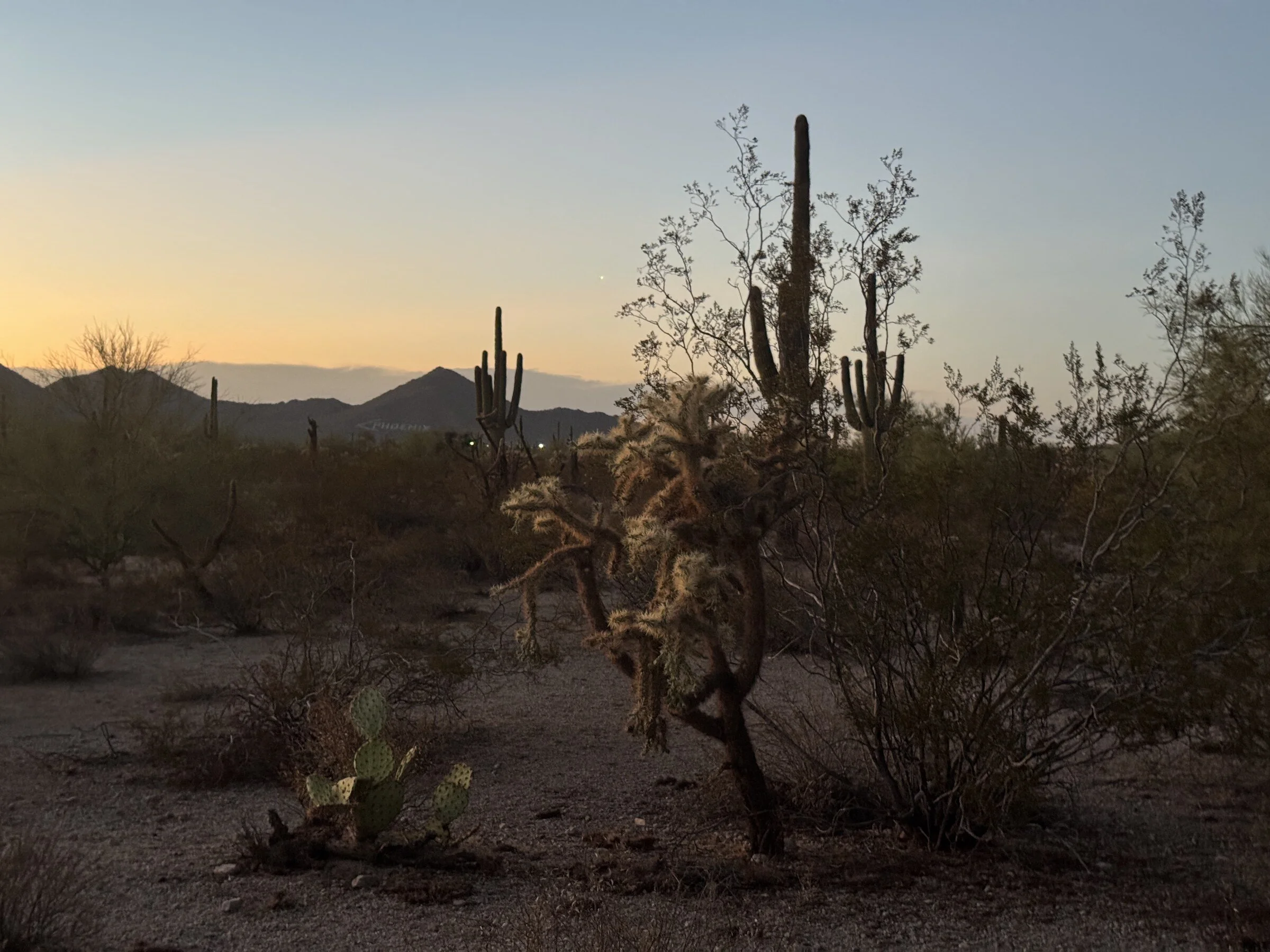
Crismon Trailhead at Sunset
Usery Mountain Regional Park, Arizona · August 24, 2026
Location: Crismon Trailhead, Usery Mountain Regional Park, greater Phoenix, Arizona
Elevation: approximately 1,770 feet
Time: Early evening through sunset and dusk
Conditions: Approximately 102°F near the beginning of the walk; around 100°F after sunset; hot and dry
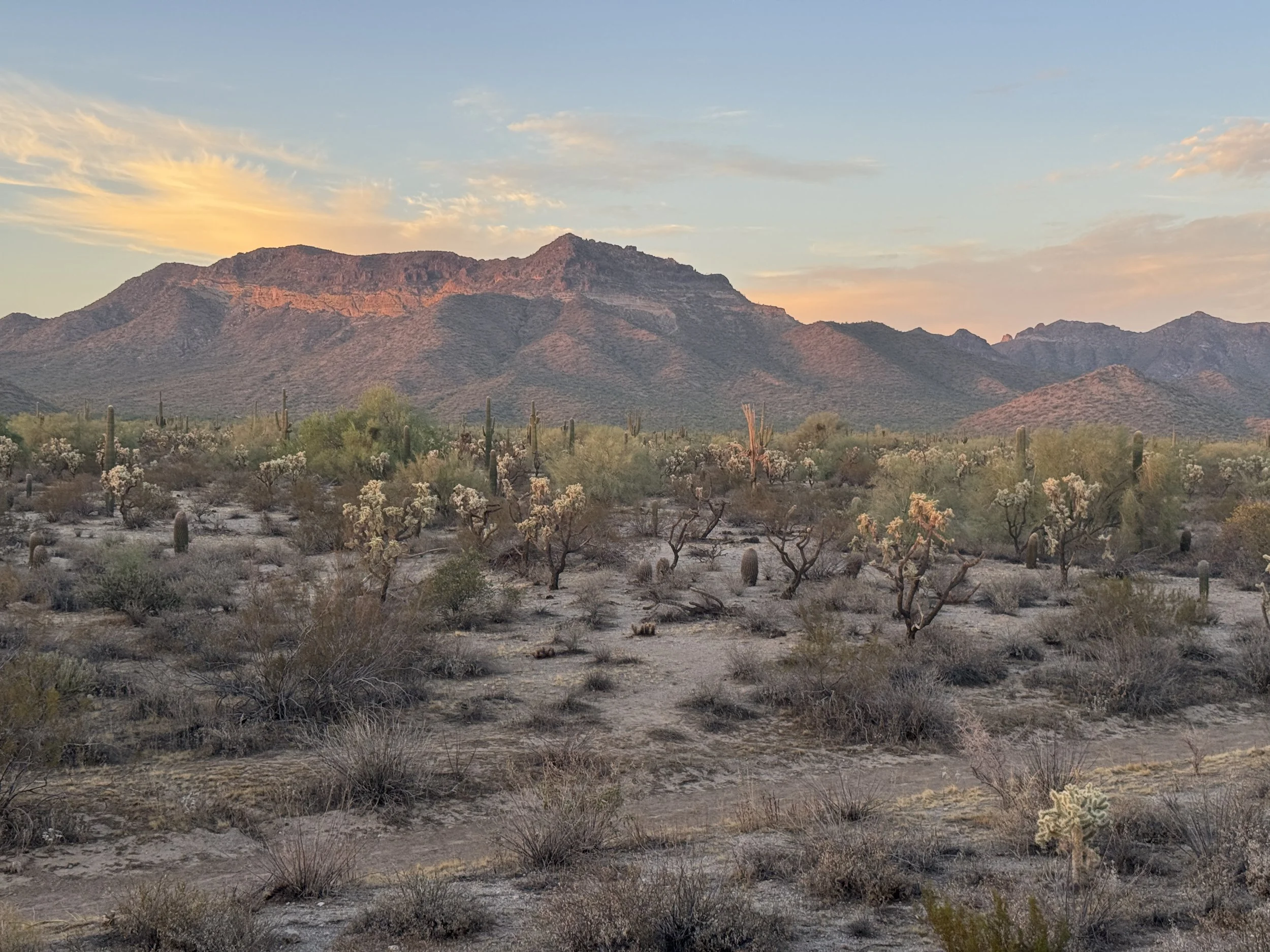
Habitat: Sonoran Desert with saguaros, chollas, prickly pear, creosote, palo verde and diverse woody shrubs and small trees among extensive open mineral ground
It was still about 102 degrees when we arrived at Crismon Trailhead in the early evening. By the time the sun disappeared behind the mountains, my phone still showed around 100.
And yet I was comfortable.
That surprised me.
Earlier in the day, 108 degrees beneath the blazing Phoenix sun had felt genuinely harsh. Here, after the direct sunlight disappeared, a temperature I would ordinarily describe as extreme felt remarkably pleasant.
It was my first small lesson in something I suspect I will learn repeatedly in the Sonoran Desert:
Time of day matters enormously here.
It was also one of my first opportunities to stop moving through the Sonoran Desert and spend some time actually looking into it.
I'd been in the Phoenix area for only about a day. Saguaros were still thrilling. Chollas and prickly pears were becoming familiar shapes. Palo verdes were beginning to look like something other than strangely green trees.
But walking slowly through this landscape revealed how incomplete that picture was.
There were woody plants everywhere.
Small trees. Large shrubs. Little shrubs. Thorny things. Nearly leafless things. Plants with tiny compound leaves. Plants I couldn't identify at all.
The saguaros provided the spectacular vertical punctuation, but underneath them was a surprisingly complicated woody community.
I had expected the Sonoran Desert to give me plenty to learn.
I hadn't quite appreciated how much.
Learning to See the Shrubs
One of my favorite discoveries of the evening was an otherwise fairly inconspicuous shrub: creosote bush (Larrea tridentata).
From a distance, it could easily disappear into the category of "green desert shrub."
Then I got closer.
I photographed the small leaves and noticed peculiar little white structures that looked—and even felt—like fuzzy balls. Close photographs showed them to be small fruits densely covered in silky white hairs.
That is exactly the kind of field discovery I love.
A plant that had been part of the anonymous background ten minutes earlier suddenly had characters I could recognize.
The desert began resolving into individuals.
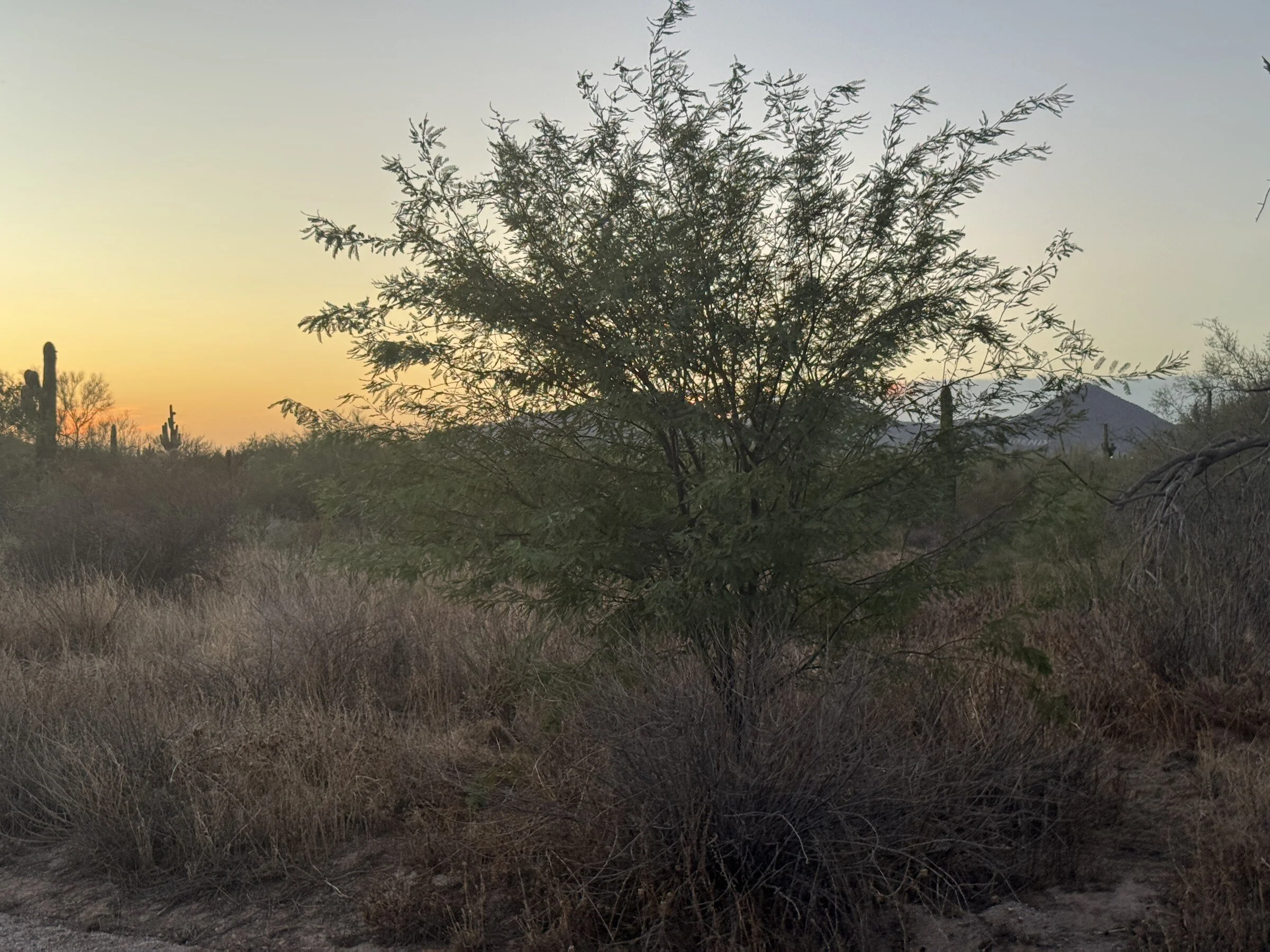
Elsewhere, fine compound foliage reinforced another theme I'd been noticing throughout New Mexico and Arizona: the prevalence of small-leaved woody plants, particularly members of the legume family.
Mesquites, palo verdes and other superficially similar desert trees and shrubs can initially create the same general impression: airy crowns assembled from tiny leaflets, sometimes accompanied by rather convincing weaponry.
But once I started looking carefully, "small compound leaves" clearly wasn't going to be enough.
Leaf construction matters. Leaflet number and size matter. Bark matters. Thorns matter. Pods matter. Overall architecture matters.
Learning this group is going to take some time.
That's part of the fun.
A Heavily Armed Landscape
My husband offered a succinct piece of desert advice:
Don't touch anything.
That's perhaps a little extreme.
But not by much.
Cactus spines were obvious, of course, but formidable defensive structures occurred throughout the vegetation. Putting a leaf or twig into my hand for a photograph quickly became an exercise in careful visual inspection first.
There's an ecological logic to all this armor.
Living tissue represents an investment, and in a place where water is frequently scarce, replacing tissue can be expensive. A cactus in particular carries a substantial reservoir of water-rich succulent tissue worth protecting from herbivores.
But the Sonoran plants around me weren't all solving the problem in the same way.
Creosote uses tiny resinous leaves and chemical defenses.
Palo verdes take another remarkable approach. Their green twigs, branches and trunks contain chlorophyll and can continue photosynthesizing when drought makes maintaining a full complement of leaves too costly.
Cacti store water in succulent stems and surround themselves with spines.
Other woody plants combine small leaves, drought tolerance and physical defenses in still other ways.
Walking through the Sonoran began to feel like visiting an evolutionary engineering exhibition:
Here are many different answers to the question, "How do I remain a plant here?"
The Cholla Problem
I also learned very quickly that "cholla" isn't really an identification.
It's the beginning of one.
Chollas were extraordinarily conspicuous along this walk. Some of the landscape photographs show them repeated across the desert floor beneath the saguaros, almost creating a middle layer between the low vegetation and the taller desert plants.
One particularly substantial individual deserved a much closer inspection.
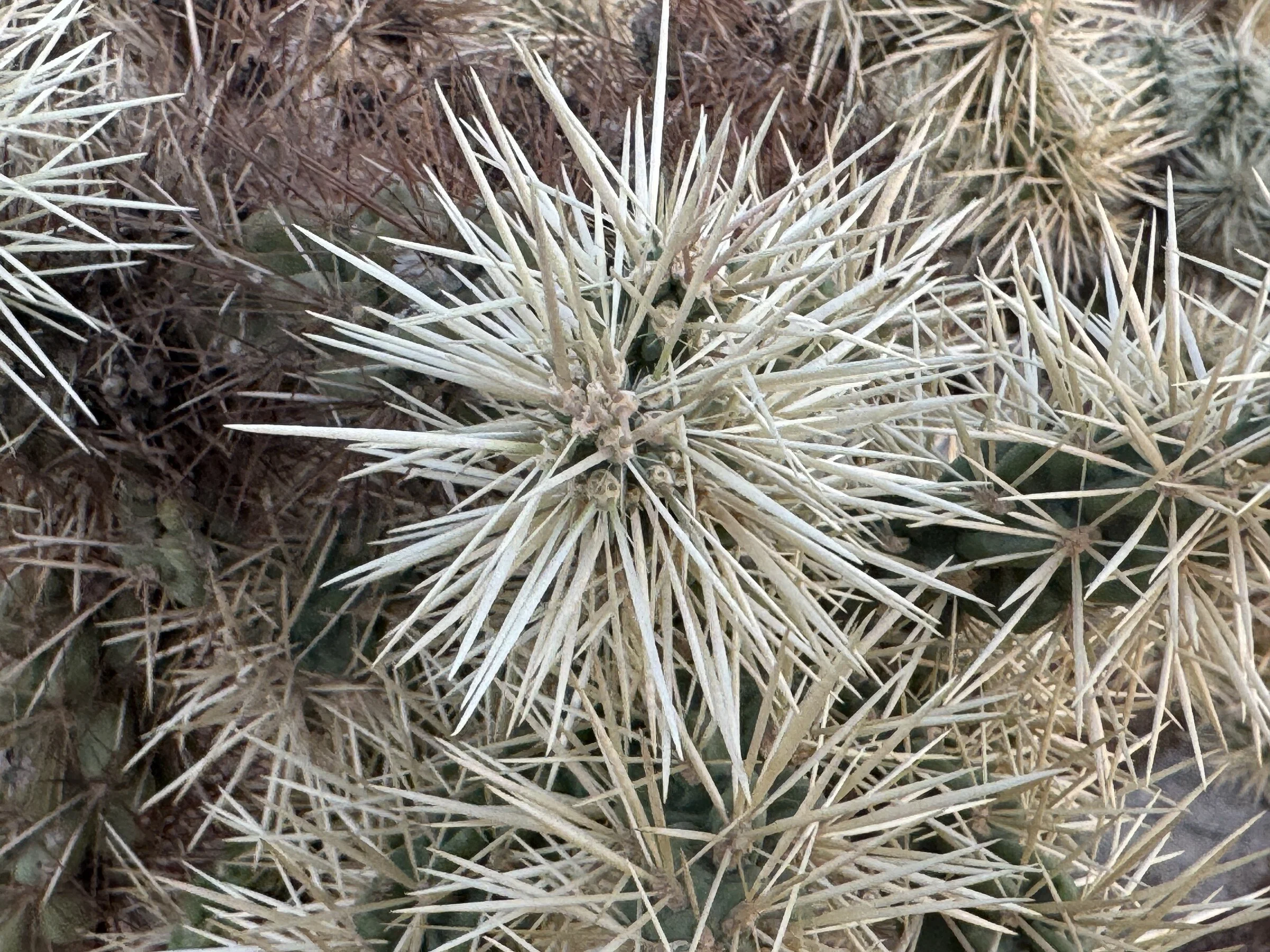
I photographed the whole plant, then moved progressively closer to its branches and spines. The terminal growth appeared almost soft from a distance because of the extraordinary density of pale spines.
It was, needless to say, not soft.
The photographs also revealed something I found more interesting than the spectacular spines: older portions of the plant became dark and woody, and dead sections exposed the distinctive perforated woody skeleton inside.
That sequence—whole plant, young growth, older branches, trunk and dead skeletal material—was a useful reminder not to learn a plant from one attractive feature.
And species-level cholla identification remains something I want to approach cautiously. This outing taught me enough to realize how much more there is to learn about joints, spines, fruits, flowers and growth forms before every cholla gets a confident name.
The Dead Still Belong Here
I found myself photographing dead plants, too.
One substantial dead tree made a particularly striking silhouette against the evening sky. A dead saguaro caught my attention as well.
That instinct came with me from the Pacific Northwest.
Learning about old-growth forests taught me that a tree doesn't cease to belong to an ecosystem when it dies. A standing snag or fallen trunk can continue participating in the forest for years.
The ecological machinery is different here, but the principle survives.
With moisture frequently limiting decomposition, dead woody structures can remain conspicuous in the desert. They can provide perches, cavities, shelter, insect habitat and physical structure long after photosynthesis has stopped.
Saguaros offer an especially dramatic example. After the succulent tissues disappear, their woody internal ribs can remain behind as a skeletal record of the plant that once stood there.
So dead plants are staying in my photographic vocabulary.
They aren't clutter in the landscape.
They're part of the landscape.
The Space Between the Plants
Another thing I was learning to see was something that initially looked like nothing at all:
the ground between the plants.
Coming from western Washington, my eye is accustomed to vegetation occupying nearly everything. Trees overhead. Shrubs underneath. Ferns and herbaceous plants below those. Mosses, fallen needles and decomposing organic matter covering the ground.
Here, enormous amounts of gravel, rock and exposed mineral soil remained visible between perennial plants.
At first, that can read as emptiness.
It isn't.
Water arrives episodically and moves unevenly through this landscape. Differences in soil, drainage, shade, slope and tiny changes in topography can affect where plants have opportunities to establish and survive.
Open ground is therefore part of the structure of this ecosystem just as surely as the saguaros and shrubs are.
My wider photographs increasingly showed the pattern: tall saguaros above scattered woody plants, chollas and prickly pears occupying another layer, smaller shrubs below them, and open mineral ground connecting everything beneath the mountains.
This wasn't an empty landscape decorated with cactus.
It was a plant community I hadn't yet learned how to read.
Sunset Changes the Desert
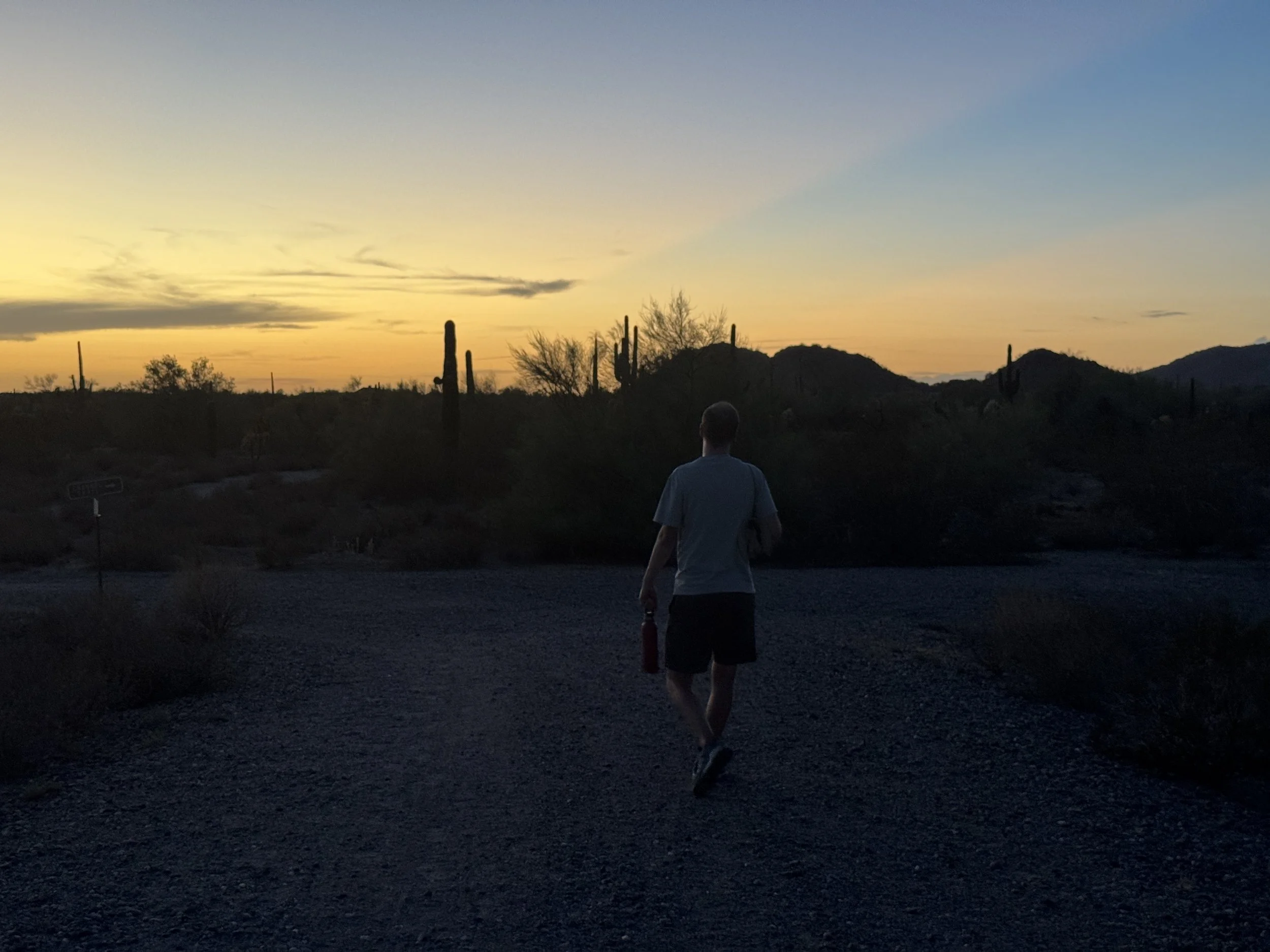
We stayed through sunset.
The mountains darkened. Saguaros became silhouettes. The intense direct sunlight disappeared.
My phone still showed around 100 degrees.
And the walk felt remarkably comfortable.
The difference between 108 degrees under the afternoon sun and roughly 100 after sunset was far greater than those eight degrees suggested. Direct solar radiation had disappeared, dramatically reducing the heat load on my body. In the dry air, evaporative cooling could work without the sun continuously adding energy back.
That experience suggested another important lesson for future desert fieldwork:
A Sonoran naturalist has to learn hours as well as seasons.
Dawn, midday, evening and night aren't merely different lighting conditions. They can represent profoundly different thermal environments.
And they matter to the animals, too.
I didn't see a rattlesnake that evening.
I didn't see a scorpion.
That certainly doesn't mean none were nearby.
As conditions became more comfortable for us, the same transition was opening another part of the Sonoran day. Rabbits and nocturnal rodents could become more active. Bats could take to the air. Coyotes could begin moving. Javelinas could forage through the vegetation.
The landscape wasn't shutting down for the night.
It was changing shifts.
Becoming a Beginner Again
My strongest impression after this walk was simple:
There is so much here.
There isn't just "mesquite."
There are mesquites and numerous other small-leaved woody plants that I'm going to have to learn individually.
There isn't just "cholla."
There are different chollas.
There isn't just "prickly pear."
And behind the charismatic cacti is an entire flora of woody shrubs and small trees that I currently can't name.
I find that tremendously exciting.
I've spent years becoming familiar with the forests of the Pacific Northwest. I can walk into those landscapes now with a vocabulary I didn't have when I arrived.
Here, I'm a beginner again.
And after only about a day in the Sonoran Desert, I was already enchanted by it.
At Crismon Trailhead that evening, I could recognize some of the major characters: saguaro, creosote, palo verde, prickly pear and cholla.
Around them were dozens of questions.
That's exactly where I want to be.
Naturalist's identification note
This was an early outing in an unfamiliar flora, and identifications should reflect that. Creosote bush (Larrea tridentata) and saguaro (Carnegiea gigantea) are strongly supported by the photographic record. Broader identifications such as palo verde, cholla and prickly pear are useful where the photographs support them, but species-level names should not be forced when diagnostic evidence is insufficient.
Unidentified woody plants are deliberately retained as unidentified rather than converted into false precision. They are part of the value of this field record: a snapshot of what I could—and could not yet—recognize during one of my first walks through the Sonoran Desert.